No Time for Comedy

in No Time for Comedy
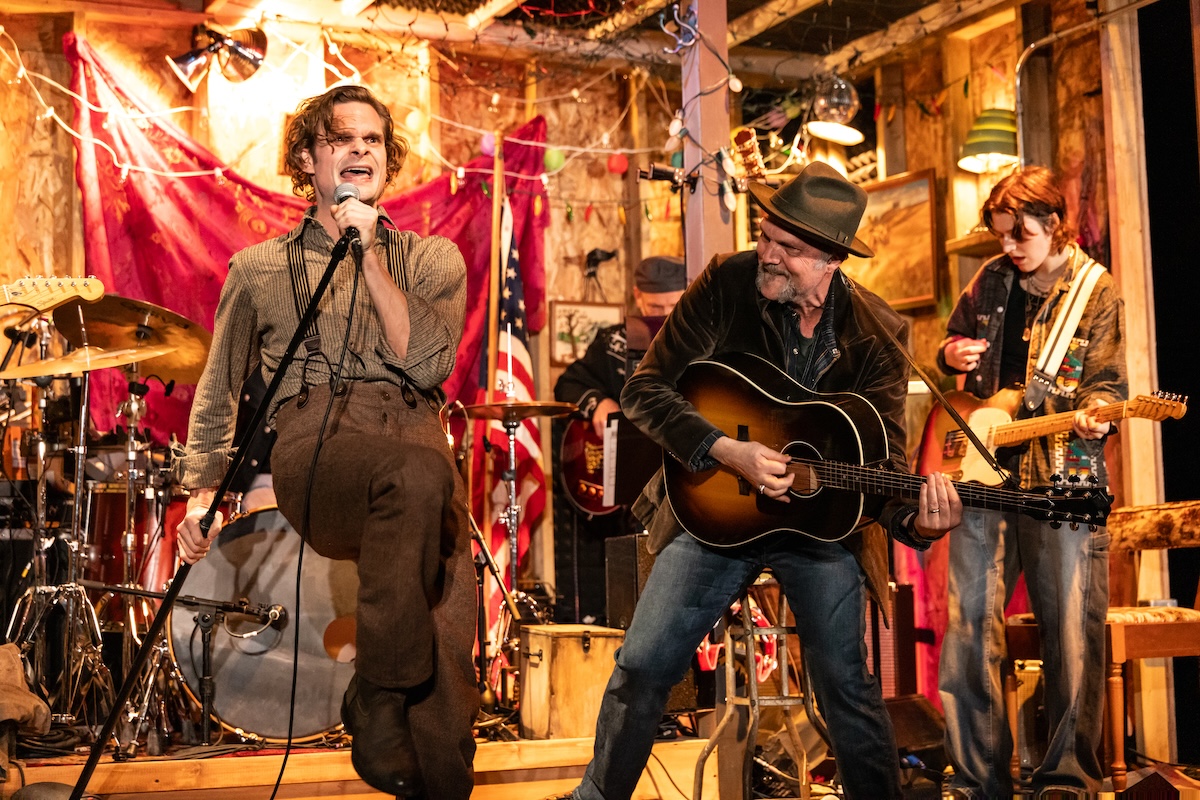
(Photo: Richard Termine)
Jonathan Bank, artistic director at the Mint Theater, where the mission is to champion “worthy but neglected” plays, says he doesn’t schedule productions very far in advance. He likes to match what he produces with “the moment.” So it wasn’t until after September 11, 2001 that he decided to revive S.N. Behrman’s 1939 play No Time for Comedy. Bank undoubtedly figured that if the urbane Behrman (1893-1973) were still alive today, he might write something close to what he wrote 64 years ago, give or take a few changes in stage conventions. The piece would address the question of whether playwrights shirk their duty if, in precarious times, they continue to produce gossamer entertainments. Bank wants audiences in 2002 to examine the pertinence or impertinence of comedy just as Behrman’s audiences did during the gathering storm of the late ’30s.
The original production of No Time for Comedy, a vehicle for Katharine Cornell and Laurence Olivier, featured the latter as a masterful comedic playwright and the former as his wife and leading lady. The writer, Gaylord Easterbrook, has come to believe that the world is obsessed with death; it’s that subject in general, and the Spanish Civil War in particular, about which he must express his deepest feelings. This leaves comedienne Linda Easterbrook, known professionally as Linda Paige, without the prospect of a play for the coming theater season. More significantly, it leaves her concerned that the husband she loves is laboring over a drama that won’t bring out the best in him. Meanwhile, Gaylord is being encouraged in his new pursuit by Amanda Smith, the wife of ultra-rational banker Philo Smith. Amanda sees her life’s assignment as guiding men of promise to ever more profound achievements, and she has latched on to Gaylord because Philo refuses to be swayed by her dilettante-ish maneuvering–but Amanda makes so much headway with the addled Gaylord that he proposes to divorce Linda and marry her. Philo tries the same tactic with the bemused Linda.
In this game of musical chairs, Behrman’s prevailing melody is witty banter. It’s unlikely that anyone ever spoke the kind of high-flown language heard here outside a proscenium; but Behrman, often called the American Noël Coward, was able to make ticket buyers wish they could chat with such intelligence and warmth. Though Linda makes perfect sense when she argues with Gaylord about his duty as a dramatist and he, in his turn, makes almost no sense, both of them have persuasive moments on the issue at hand, as do the Smiths.
While Behrman turns his discourse on comedy into a lively debate, he also aims to shed light on the nature of marital love by examining two marriages to see what makes them work. Gaylord and the ever-understanding Linda adore each other despite their differences and Gay’s temporary shortsightedness. Philo, who finds the idea of a second divorce “undignified,” and Amanda are something else again; they have an understanding that is rapidly revealed as a fundamental misunderstanding. Behrman’s compare-and-contrast partnerships ring true and are as insightful on the realities of matrimony as are his other observations on the relevance of comedy.
The play does have a noticeable flaw in the character Gaylord Easterbrook. At no point during the three acts–the Mint production includes both intermissions–does Gaylord seem to be anything other than a buffoon. Nothing he says or does makes him sound like a fellow who is skilled at getting sophisticated laughs with artful scripts; the three successes he’s had with Linda as star have to be taken on faith. Throughout the proceedings, he’s impulsive and callow and hardly Linda’s equal. (On the other hand, this may be thought of as a reflection of real life, wherein people are constantly saying things like “I don’t know what she sees in him” or vice versa.)
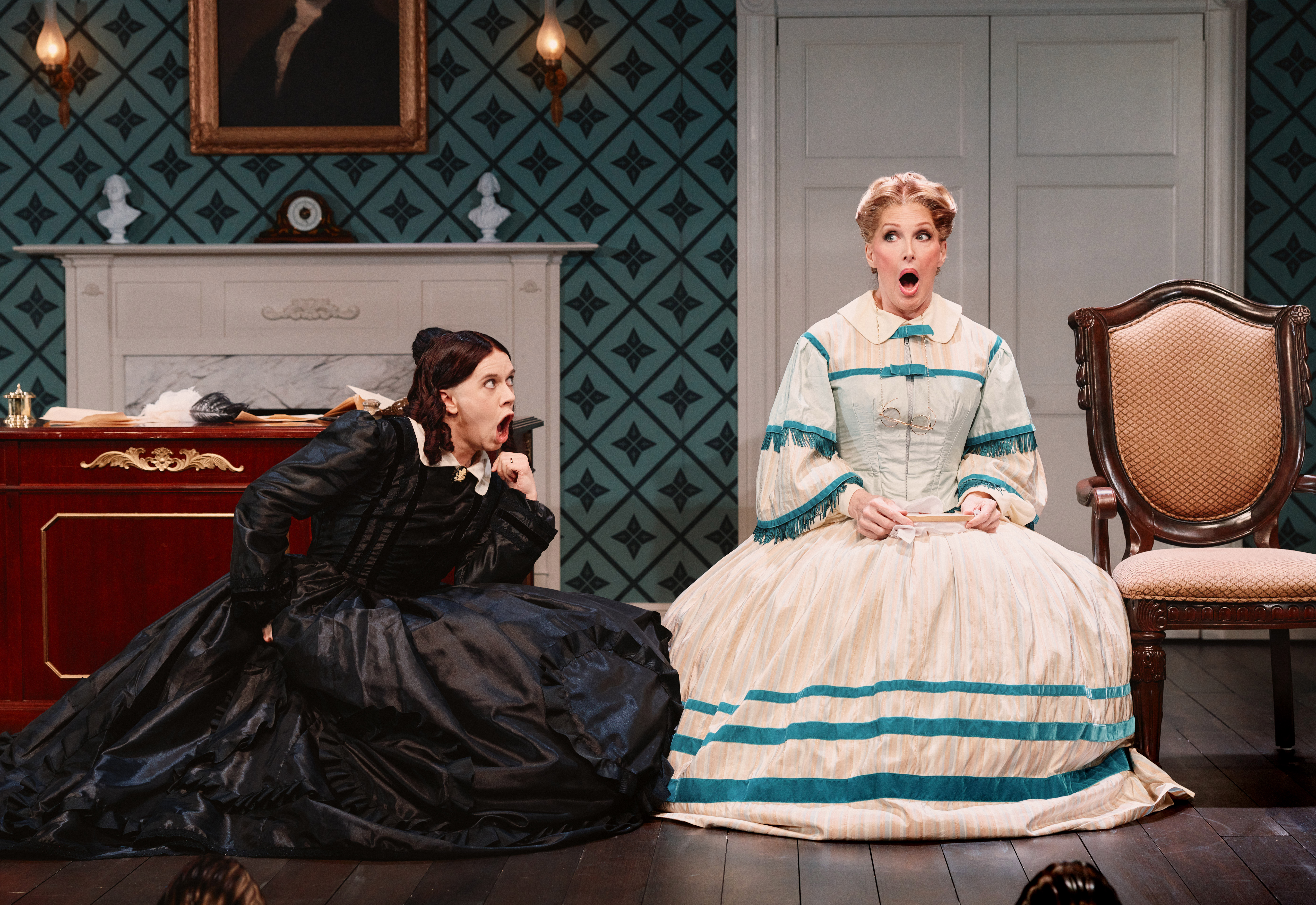
Director Kent Paul nicely dusts off and polishes up the Behrman blab-fest, in which the word “gay” is used as both a nickname and as a synonym for “merry” and in which “lushing” is a verb. It may go without saying (at least to those who remember Katharine Cornell, Laurence Olivier, John Williams, and Margalo Gilmore) that this is a show necessitating a high style of acting. As they blithely indulge in badinage, the players also have to know how to sit straight-backed on chairs, glide gracefully across rooms, and light cigarettes with panache.

in No Time for Comedy
(Photo: Richard Termine)
Paul’s thesps have the basics down. Leslie Denniston’s Linda has a beautiful smile and the kind of straight nose that Flo Ziegfeld said he could do wonders with; she sits straight-backed on chairs and delivers soigné remarks with relative ease. Simon Brooking plays Gaylord’s obtuseness to the hilt, though he never finds places in the material to suggest the suavity that might have swept Linda off her well-shod feet. As Philo, Ted Pejovich comes closest to Behrman’s notion of savoir faire, sleekly pulling out his silver cigarette case from his suit pocket. Hope Chernov, a dark beauty with deep-set eyes, cleverly leavens Amanda’s fatuity with charm. Shawn Sturnick is Makepeace (“Pym”) Lovell, Behrman’s shrewd take on the kind of playboy whom women love and men disdain. Jason Summers as Robert, the haughty butler, gets laughs simply by carrying a tray of drinks from here to there, and Diane Ciesla is delightful as Mary, the kind of parlor maid who seems to be on the phone at the start of every ’30s comedy.
Another word about Mary: In Behrman’s script, she’s named Clementine and is African-American. Apparently, artistic director Bank got a case of the PCs when he looked at Clementine’s lines and saw “dis,” “dey,” and “dat” in abundance. So out went that dialect in favor of Irish locutions that are, ironically, no less stereotypical. Whereas Clementine refers to Gaylord as “a nacheral honey,” Mary now calls him “a broth of a boy.” (Behrman’s people, present at the dress rehearsal, signed off on the changes.)
The Mint hasn’t the kind of money needed to give this kind of play the glittery look it should ideally have, but Tony Andrea’s adaptable beige, cream, and brown set is more than sufficient, as are Jayde Chabot’s costumes. Peter West’s lighting and Jane Shaw’s sound are fine as well–although, before the first act begins, Cole Porter is heard singing at least one song he didn’t write until the early ’50s. “Never give anything away that you can sell,” Porter sings. Taking on No Time for Comedy, the Mint Theater sells it.