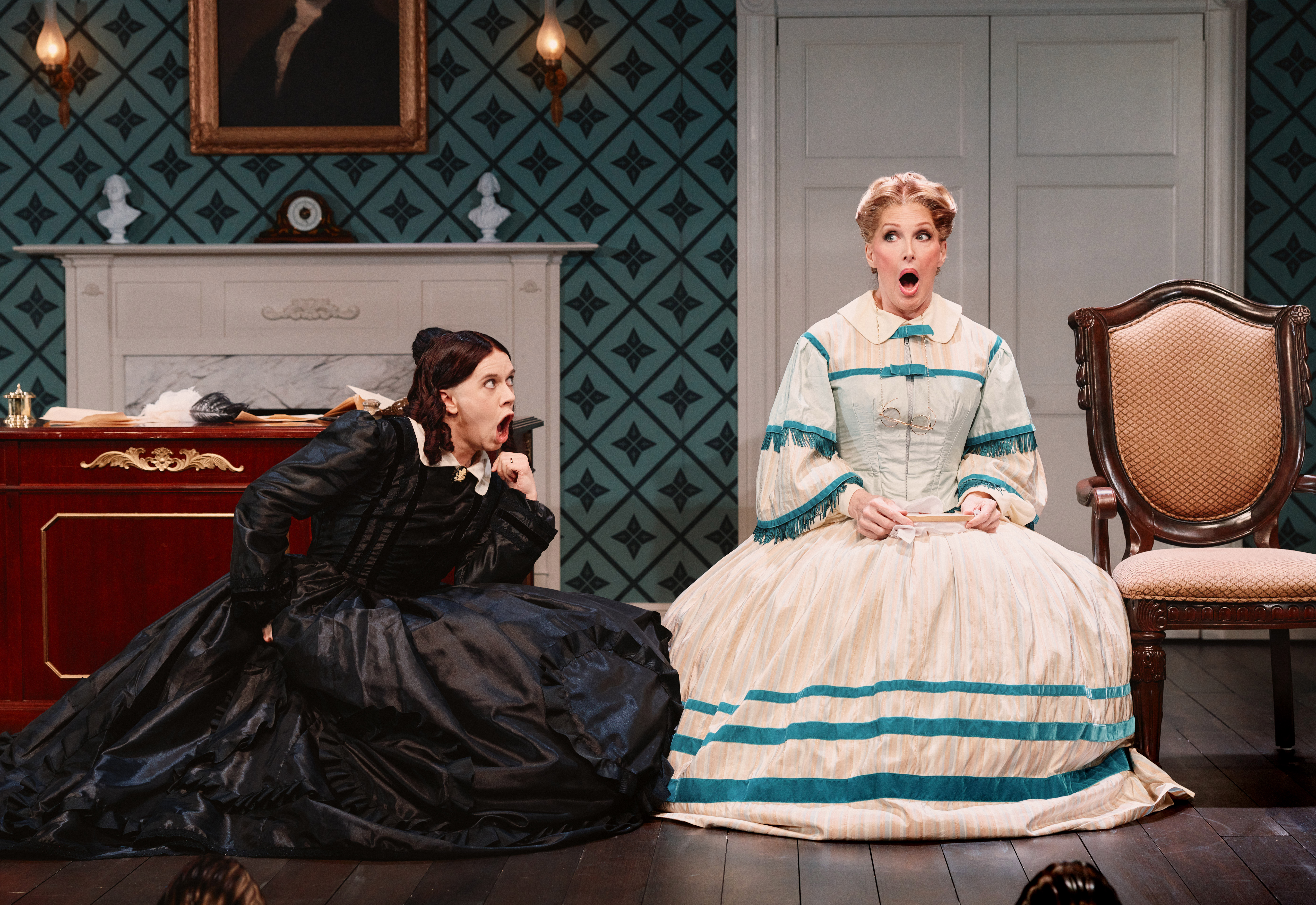


Can-Can

(Photo © Joan Marcus)
“It’s interesting,” the man in front of me remarked to his wife last night as we filed out of Can-Can, this season’s opening production of the wildly popular Encores! series of musicals in concert at City Center: “This show is from 1953, and it’s about absolutely nothing.” Presumably, the fellow is not a critic, but I think he nailed it. Great things were happening in American musical theater a half-century ago; there were Rodgers and Hammerstein, of course, plus Frank Loesser and Jule Styne and Harold Rome finding their full voices. It was a time when real emotion and dramatic consistency even began to creep into boulevard musical comedies. (You can see evidence of this a few blocks south in Wonderful Town, another 1953 title now on Broadway in a production that originated at Encores!) But consistency and emotion are conspicuously absent from Can-Can, and the efficient if somewhat anonymous Encores! presentation doesn’t offer many clues as to what kept the original running for more than two years.
Abe Burrows’s book, streamlined for Encores! by David Lee (the running time is a mere two and a half hours), plays not as a story but as a series of settings and situations. We’re in Paris, 1893, on the Left Bank. La Mome Pistache (Patti LuPone) is always having run-ins with the gendarmes over the lewd dances performed at her boîte. The newly appointed, self-righteous Judge Aristide (Michael Nouri) investigates the joint to see for himself and falls quickly under the spell of Pistache. What should happen next is that they should learn something from each other — she to care for someone besides herself, he to stop being so judgmental — but their relationship is sketched out in such inconsequential shorthand that the actors can do little more than strike attitudes, bickering and reconciling throughout the evening. This being an old-fashioned musical, and not in the positive sense, most of its scenes end with loud, thudding punchlines. The plot also involves a second couple, a perky dancer (Charlotte d’Amboise) and a terrible sculptor (Reg Rogers) living la vie bohème, but the thinness of these two characters makes the first couple look like they stepped out of a Chekhov play.
Do the Cole Porter songs save the show? Non. Some are attractive and some became standards — “I Love Paris,” “C’est Magnifique,” “It’s All Right with Me” — but even the hits display this genius songwriter at less than his best. The score is heavy on list songs — simple, repetitive ones — and even when an honest ballad surfaces, it doesn’t get under your skin (to paraphrase a prior Porter great). “I Am in Love” has the suave beguine beat associated with Porter, but what is “a stampede of love?” And would any disappointed lover really ponder, “Such conflicting questions ride around in my brain / Should I order cyanide or order champagne?”
What, then, kept the original Can-Can kicking for 892 performances? Personality, I’m guessing. Critics in 1953 weren’t bowled over by the material, either; but there were so many fun, idiosyncratic people onstage doing such bizarre and/or energetic things in such a naughty French setting amidst lavish Jo Mielziner trappings that audiences forgave it. (An even slightly lascivious show must have felt like a breath of fresh air at the peak of the McCarthy era.) The original Pistache, Lilo, was authentically Gallic and fascinatingly odd, with a habit of adding “m”s to the end of every lyric line (“Try to remember, ma bellemmm”). In this respect, Encores! was canny in hiring LuPone, a genuine star with timing, magnetism, and diction nearly as strange as Lilo’s. Sure, she masticates on her consonants; and you can’t really believe that her heart would palpitate over Nouri, the Stick That Sings (he repeatedly sang ahead of the orchestra last night). But she’s breezy, she’s individual, and she warbles with a music-hall abandon that Piaf might have envied. If there were more of LuPone here, there’d be more of a show.

(Photo © Joan Marcus)
The soubrette role of Claudine made Gwen Verdon a star. Charlotte d’Amboise, who has played Verdon roles before, is a delightful dancer, petite and precise, and quite well-trained vocally. She gets four showpiecess here, all choreographed by Melinda Roy (some of the other choreography is by Casey Nicholaw): a leaping quadrille, a rather haphazard “Garden of Eden” ballet, an exciting Apache dance, and the titular can-can finale that apparently wraps up all the conflicts in the script since the show just ends there. But d’Amboise hasn’t anything like Verdon’s electricity or identifiability — the throatiness, the impishness, the ability to flesh out through dance whatever the authors omitted in the text. Opposite her, Rogers is capable and suitably over the top but, again, one searches in vain for the added flair that might transcend the rote writing. Hans Conreid seems to have had it, judging from his performance on the original cast album; Rogers either doesn’t have it or simply hasn’t had the time to figure out how to jolly an audience along. Or maybe Lonny Price, the director, hasn’t come up with the right shtick to spark the action; the show is played relatively straight and there are few moments that ignite those old burlesque fires.
With so little at stake dramatically, there’s plenty to enjoy on City Center’s stage: Michael Kosarin’s spirited conducting of Philip J. Lang’s zippy old orchestrations, a well-drilled and sexy corps de ballet, Kenneth Posner’s unobtrusive pastel lighting, and old pro Eli Wallach milking his every moment on stage as a randy judge. This being Can-Can, you know that sooner or later the dancers will shriek, run wildly about, and do splits and cartwheels as a fetching LuPone chews on one of Porter’s zingier silly-list lyrics (“If a bass in the Saskatchewan can / Baby, you can can-can too”). But at no point during the proceedings will you care if Pistache is hauled back to jail or not, if Aristide will be able to balance his appetites for the officious and the libertine, or whether Claudine ends up with her sad-sack sculptor or the silver-tongued art critic (Paul Schoeffler) who tries to woo her away with a dull comic ballad. As a relic from the B-list of 1950s musicals, Can-Can just about gets by; but if Encores! means to convince us that it’s worthy of a transfer to Broadway, like Chicago or Wonderful Town, it can’t-can’t.
Featured In This Story