

Observe the Sons of Ulster Marching Towards the Somme

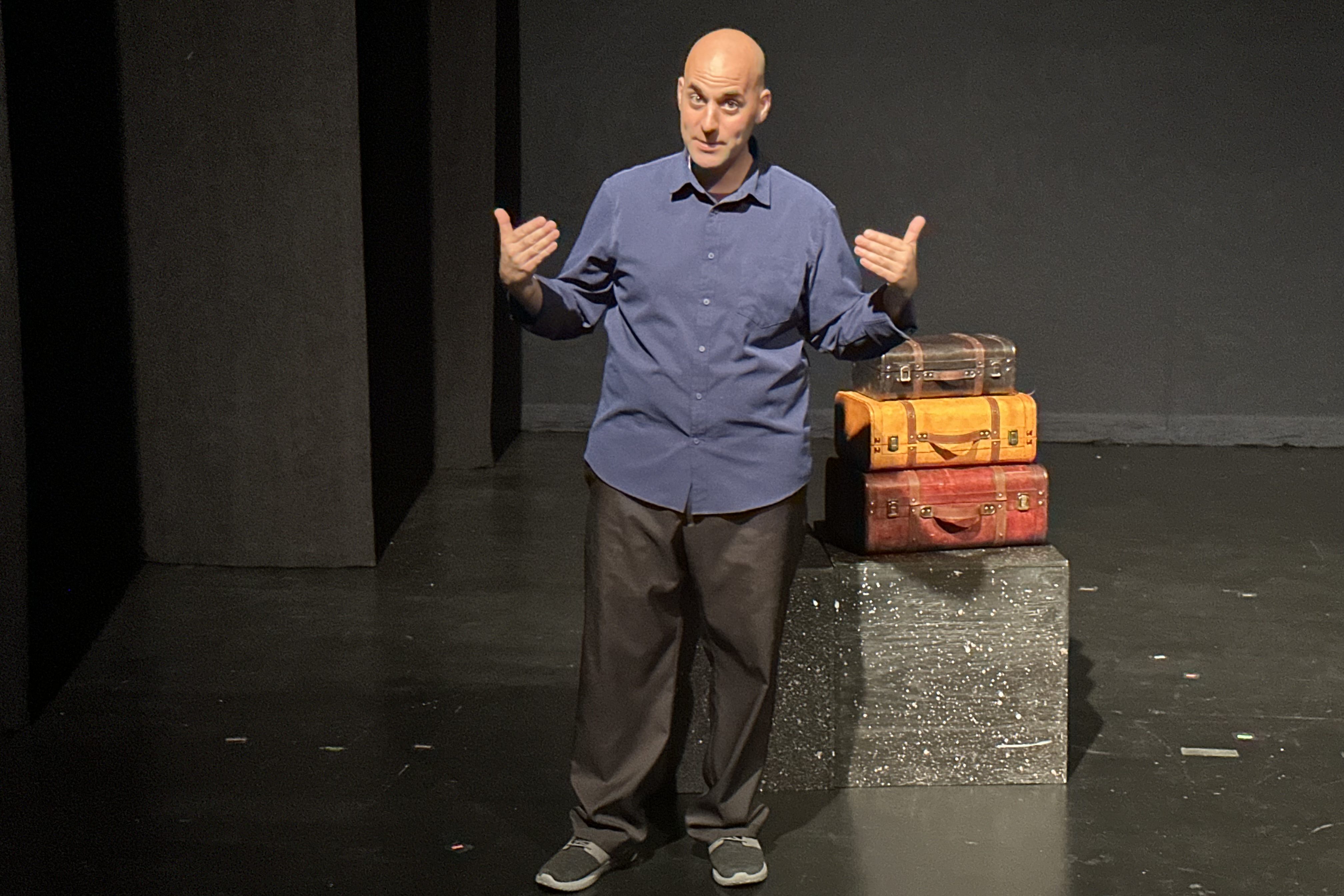
Jeremy Shamos in Observe the Sons
of Ulster Marching Towards the Somme
(Photo: Carol Rosegg)
Silence in the theater can indicate many things. Often, for instance, what’s transpiring on stage has so affected the audience that even its breathing slows, lest concentration be disturbed. That’s the kind of astounding hush heard towards the end of Frank McGuinness’s Observe the Sons of Ulster Marching Towards the Somme, as eight soldiers whose shifting interactions have eventually drawn them together prepare to enter a Great War battle from which none, or few, expect to return. This non-Simon and Garfunkel sound of silence provides a case-resting argument for the unique quality of live theater; it’s experienced nowhere else.
Gratitude for the sequence is greatly due, of course, to playwright McGuinness, who throughout his prolific career has had the plights of soldiers on his mind — soldiers as soldiers, as well as soldiers as stand-ins for the average Joseph. The dramatist’s continuing concern is evident in Someone Who’ll Watch Over Me and in his more recent Dolly West’s Kitchen, which takes place on the Irish home front during World War II.
In Observe the Sons of Ulster Marching Towards the Somme, written in 1985 but only now being given a superb New York premiere production, McGuinness addresses a string of issues. Among them are the traits that constitute maturity in a man, the comforts of male bonding, fear as an element of bravery, the definition of faith, and the severe human wages of armed conflict. Since these soldiers are (with one partial exception) North Ireland Protestants fighting for the glory of their loyalist beliefs, he also takes on the Irish troubles and the consequences of misplaced jingoism.
He’s shouldering quite a burden, then, and his success at maintaining a balance isn’t absolutely complete. Dividing the two-act play into four sections — “Remembrance,”
“Initiation,” “Pairing,” and “Bonding” — McGuinness lends his work the decided aroma of contrived ritual. Theatrical ritual has its pretentious dimensions, which McGuinness doesn’t avoid, particularly during some of his characters’ disquisitions on religion and leadership. What he’s attempting to get across in his higher-minded colloquies and what Observe… observers are able to sort out to their satisfaction may be two different things.
Still, throughout much of the piece, McGuinness as an Irish Catholic has written cogently and with deep feeling about eight enlisted Irish Protestants far from home in the woeful year of 1916. Their brief story, as they go about their military duties without apparent officer supervision, is recalled in flashback by one of them — presumably the only survivor, a man called Kenneth Pyper (Richard Easton). Unable in 1969 to banish the ghosts of his past, he’s trying yet again to make sense of what transpired when he was a witty, taunting, and trouble-making youth.
(“Again” is the play’s first word, by the way.) It’s Pyper who alone can report on the events — and note that his name carries simultaneously healing and ominous Pied Piper connotations.

in Observe the Sons…
(Photo: Carol Rosegg)
Once this haunted man brings on his younger self (Justin Theroux) at the end of the play’s “Remembrance” segment, the fireworks begin. In quick succession, the other seven men, during “Initiation,” enter set designer Alexander Dodge’s adaptable trenches and ramparts and begin to test each other’s strengths and vulnerabilities. David Craig (Jason Butler Harner) is naive but eager, and Martin Crawford (Christopher Fitzgerald) is also naive but not so eager to have his half-Catholic parentage discovered. Scrappy John Millen (Scott Wolf) and tentative William Moore (Dashiell Eaves) are briefly rowdy, and fallen away preacher Christopher Roulston (Jeremy Shamos) is anything but. George Anderson (Rod McLachlan) and Nathaniel McIlwaine (David Barry Gray) are the last to arrive and are ostensibly the most seasoned fellows in a play where what is ostensible doesn’t always hold up on longer examination.
During McGuinness’s “Pairing” portion, the men are positioned in twos as they develop closer ties that lead, in the final sequence, to a larger sense of bonding. McGuinness intriguingly probes boundaries of both platonic and sexual male love, suggesting that, under certain circumstances, love between men is necessary for any hope of survival. It seems to be so when Pyper and Craig get overt as part of a homoerotic strain in the play that’s addressed but not fully resolved. (A more extended homosexual love affair is depicted in Dolly West’s Kitchen.)
Oddly, McGuinness does some of his best and worst writing during this “Pairing” stretch of the play. A literal and figurative tussle between the self-proclaimed believer Roulston and the self-proclaimed doubter Crawford is the most schematic of the paired encounters. There’s also something schematic in McGuinness’s ascribing complementary attributes to each of the pairs: what one lacks, the other supplies, and the result is a fighting whole. (Do they know about this at West Point?) On the other hand, Pyper’s emergence as the unit’s most reliable motivator is neatly written, the implication being that leadership in a dubious cause carries with it the potential for unending remorse. (This production could be aimed at the Bush administration.) And as the play approaches its battle-loud denouement (Donald Holder and Jerry Yager respectively designed the lighting and sound), the game of horses and riders in which the men engage to relieve pre-battle tension is an inspired bit. So is the communal singing and praying just before fade-out, at which point the audience becomes palpably silent as described above.
In addition to McGuinness, Nicholas Martin deserves thanks, along with his cast and creative crew (the costumes are by Michael Krass). The by-play between and among the soldiers, especially during the “Pairings” part, calls for much tricky orchestrating, and Martin does it immaculately. There are times when he arranges the actors in tableaux, and these are effective without being unnecessarily arty. Martin appears to be particularly adept at allowing the performers to express just the right amount of sentiment as they challenge or support each other. A play that could easily tip over into the wrong kind of sentimentality — or, conversely, ossify into raised-fist polemic — doesn’t do so.

(Photo: Carol Rosegg)
The members of the troupe are individually and collectively flawless. Richard Easton delivers his opening monologue as a man tottering on madness as the result of continuing guilt and regret. Although he returns briefly at the end, his is a virtual in-one tour de force. (This isn’t the first time Easton has encountered his younger self on stage: Two years ago he was one half of an older/younger AE Housman team in Tom Stoppard’s The Invention of Love.) As the younger Pyper, Justin Theroux — curiously using a more pronounced upper-class accent than Easton — is wiry and dangerous. Pyper is the kind of intelligent man thrown by not knowing how to rein in his intelligence, and Theroux gets all of the complexities. The other men gnaw just as hungrily into their meaty roles, with Christopher Fitzgerald, David Barry Gray, and Jeremy Shamos stamping “I own this” on their assignments.
N.B.: This is a season of outstanding male ensembles, others being the casts of Take Me Out and Comedians. Talk about stout-hearted men.
Featured In This Story