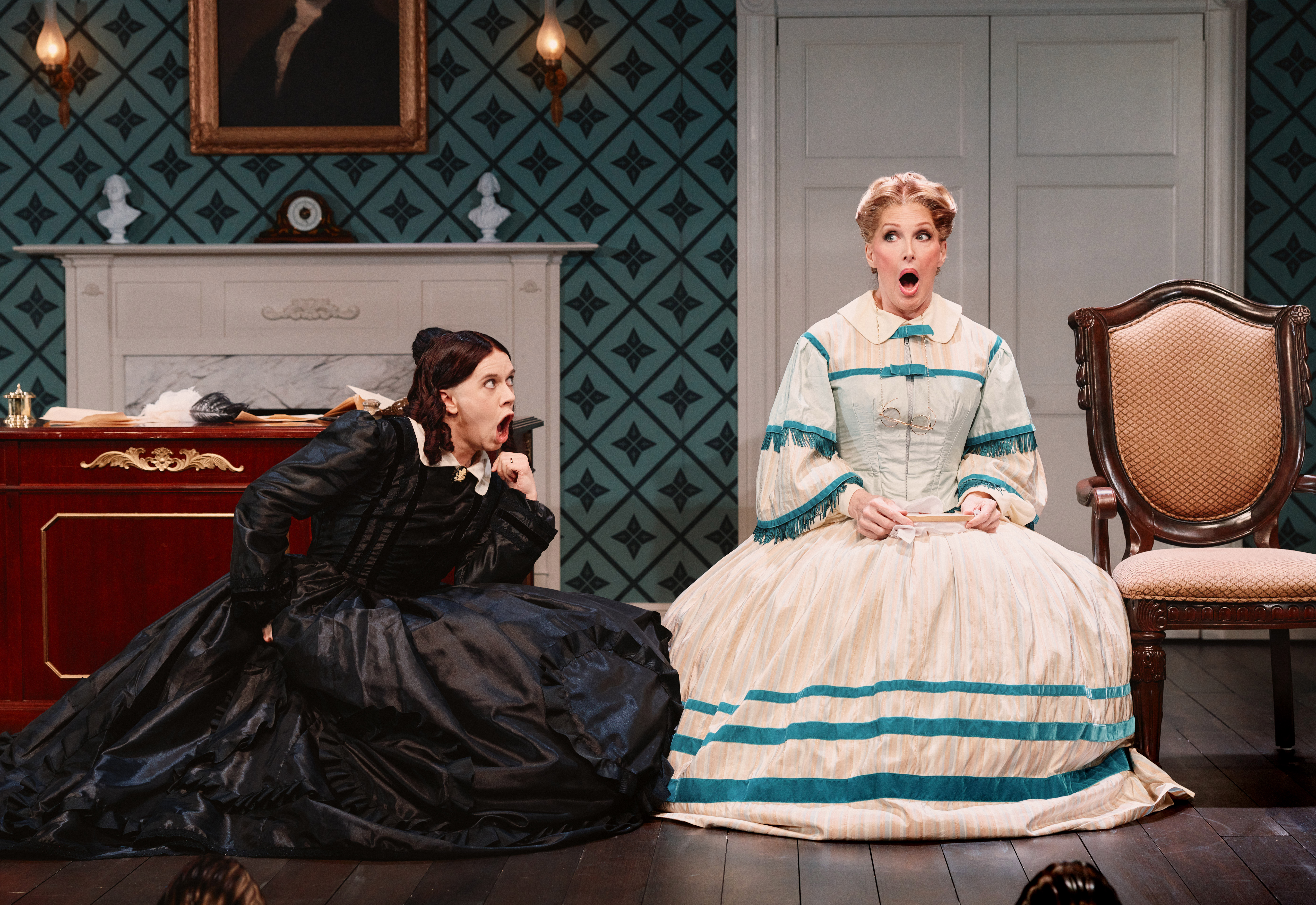

Jim Brochu Makes a Dinner Date

(© Tristan Fuge)
Jim Brochu has played everything from a dancing raisin in a classic commercial in the 1960s to Zero Mostel in his Off-Broadway hit Zero Hour, which won him a Drama Desk Award for Best Solo Performance. That work led directly to his upcoming role as the portly despot Sheridan Whiteside in the Peccadillo Theatre Company’s production of George S. Kaufman and Moss Hart’s 1939 comedy The Man Who Came to Dinner, opposite Tony Award winner Cady Huffman, which begins performances on November 26 at Theatre at St. Clement’s. TheaterMania recently spoke to Brochu about the production, Zero Mostel, and working with Lucille Ball.
THEATERMANIA: Did winning the Drama Desk Award change your career at all?
JIM BROCHU: Somebody once called me the best-known unknown actor in the country. Zero Hour put me on the map, and I get recognized now. So that’s a new addition.
TM: How did you become involved with The Man Who Came to Dinner?
JB: Dan Wackerman and Kevin Kennedy, who run the Peccadillo Theater Company, were the associate producers of Zero Hour. Dan called me about four or five months ago, and he asked if I would want to do the play. I’ve always wanted to do it, and the Theatre at St. Clements is where I made my Off-Broadway debut in April of 1968 at age 22; so it’s absolutely full circle to be there! It was a play called Endicott and the Red Cross, and it was written by Robert Lowell, who was as crazy as a hoot owl.
TM: Do you have specific memories of this play?
JB: Well, I have another connection with The Man Who Came to Dinner. My mentor was David Burns, who played Banjo in the original production. I met Davy through my dad; he worked on Wall Street, and Davy was one of his clients.
TM: What do you like most about the part of Sheridan Whiteside?
JB: It’s fun to play somebody who does not have an unexpressed thought, who does not care how the truth affects people. And Sherry, with a couple exceptions, is a truth teller. He has an unerring instinct about people.

inThe Man Who Came to Dinner
(© Dick Larson)
TM: Both Zero Mostel and Sheridan Whiteside were loud and sometimes obnoxious. Is it hard to not slip into things you did for Zero?
JB: It crosses my mind at every rehearsal. They both were obnoxious and loud, but I’m trying to separate the two. I think Zero would have made a wonderful Sheridan Whiteside.
TM: Don’t you find that Whiteside can be nasty sometimes?
JB: He can, can’t he? But I’m so goddamn lovable that it will never show! Sherry hates dictators, whether it’s Hitler or Mussolini, or Mr. Stanley in his own house–he’s a man who rules with his iron fist. But I think that Moss Hart and George Kaufman have built in the places where Sherry can be himself. He may be overboard nasty or scary-nasty, but when it comes to the people he loves, it’s different. He’s like a ringmaster with all the wonderful, crazy characters they created.
TM: This is actually a seasonal show, isn’t it?
JB: Yes, it’s set at Christmastime, and we have choirboys who are coming to sing “Silent Night” as everything goes wrong.
TM: You were friends with Lucille Ball. Did she ever give you tips about playing comedy?
JB: No, but she used to make me sing. She loved my doing “If I Were a Rich Man.” One afternoon I did it for her, and she brought in her cook, her maid, her houseman. I brought my backing tracks and my Tevye hat, and Lucy just stared at me, and she said, “You’re a born entertainer.” And I felt like I had been knighted by the Queen. We played backgammon just about every day. I remember the very first day Lucy and I played. I beat her by one point, so I won a dollar. And I haven’t played backgammon since she died.
Featured In This Story