
Kulick in the Park
TheaterMania: What drew you to The Winter’s Tale?
Brian Kulick: It’s a play that’s always haunted me, because there’s a kind of irreparableness to it. In Winter’s Tale there’s these tremendous, violent, irreparable things that happen, and one of the questions is: How do you survive that? How do you prevent it, and when it happens, how do you go on? And how time becomes a mediator for that.

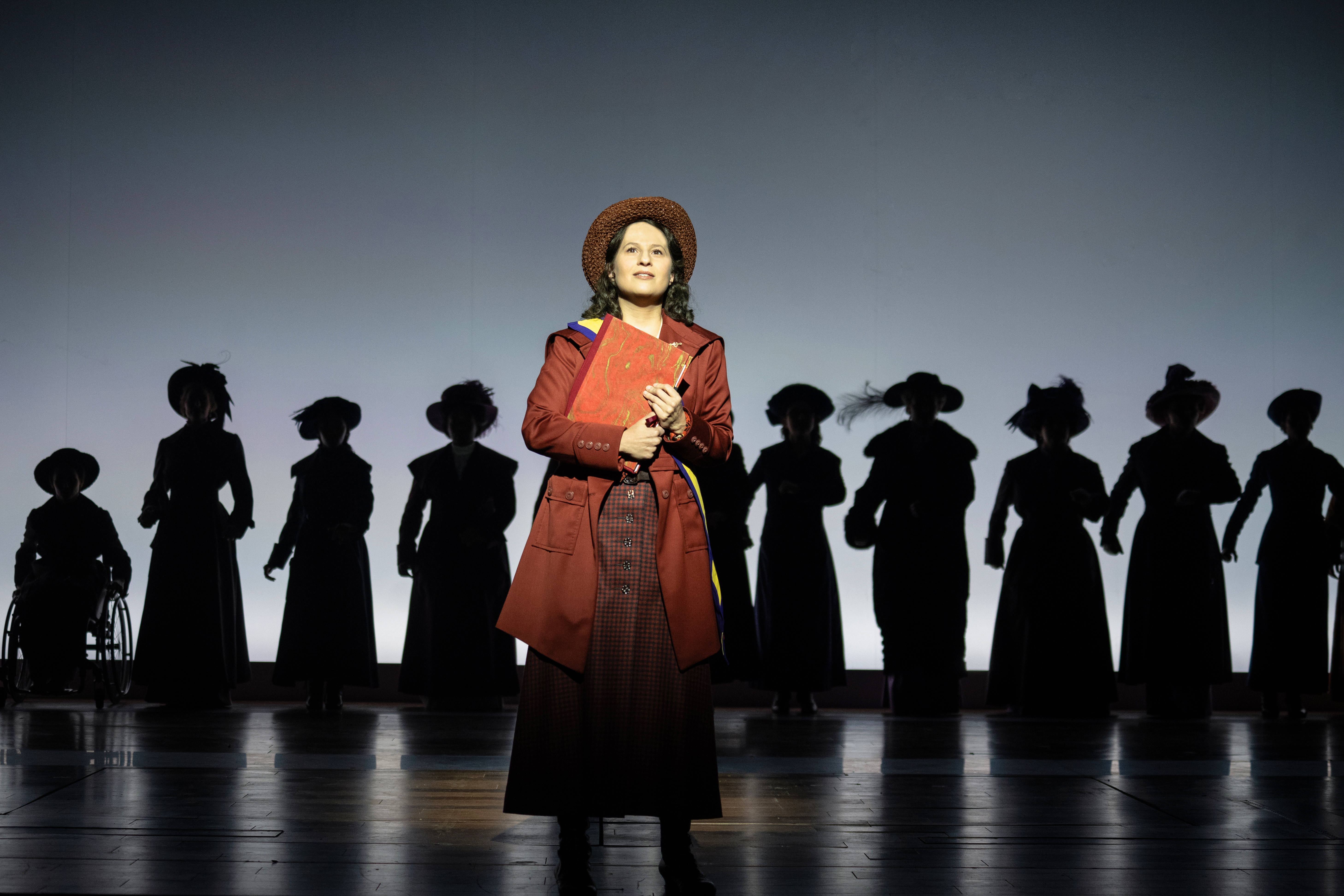
as Hermione in The Winter’s Tale
Photo: Michal Daniel
My life has been filled with emotional, irreparable moments, and how to come to peace with that has always been something that I’ve grabbled with. I thought the play would be a good play for me, at this point in my life, to look at that. There is a healing that happens in Winter’s Tale, and as we come to the end of century that has been filled with irreparable historic infamy, it felt like a good thing. So, it allowed me to reflect backwards and to project forwards.
TM: There’s that ending, with its incredible forgiveness and transformation.
Kulick: Yeah. Also, there’s just how to live, on a basic, philosophical level. After this irreparable thing happens, Leontes spends 16 years of his life in the past, and Hermione, who’s hiding away–hiding from him–spends 16 years thinking in the future of when her daughter re-arrives. So here you have one person who’s living his life in a past tense, and one person who’s living her life in a future tense, but there’s no now. There’s no present, there’s no being. And as Hamlet says, “Let be.” And here “let be” re-occurs as a phrase. There’s something about living in the present–not being pulled too far backward or throwing yourself too far forwards, but taking it moment by moment, so to speak. That also, philosophically, is a helpful way of thinking.
TM: Pericles, Cymbeline, and Winter’s Tale are all among Shakespeare’s late Romances, and The Public’s done them all recently.
Kulick: And Timon. Timon is the tale end of one cycle, and the beginning of a new cycle. And I think the sequencing, they believe, is Timon, Pericles, Cymbeline, Winter’s Tale. So for me, it’s been very fun to go from Timon, a play which is about absolute “no”–it’s so no that you yell back yes–to a series of plays that begin in the world of no and move toward yes, to some other way of reconciling those terrible things that can happen to people as they make their ways through their lives. So that’s always been very rewarding, to be able to live in that in-between from no to yes.
TM: What’s the picture on the other side of the screen?
Kulick: Well, there’s two. There’s Botticelli’s “Venus and Mars” and Mantegna’s “Triumph and Virtue”. Along with many other things that the play plays with are these issues of nature versus art, and where is art’s place in the grand scheme of things. It deals with these basic, big, huge, fundamental sort of things like the world, and the earth, and art. And the late philosopher Heideger in some ways is similar to these late Romances, because Heideger talks about: We live in a world, and we think that’s the earth–we think we live in a constructed society–and we’ve forgotten about these basic fundamental things, which are in fact the earth. And one of the ways to sort of get back to the earth, back to something fundamental, not abstract, is through art. Heideger talks about Doric
columns in a Greek temple, and how they allow you to see sky. That those columns frame sky, and otherwise you would be unaware of it–because you’re in a world, not on earth.
So one of the things that we wanted to do is move from these one-dimensional, two-dimensional images of art to sort of three-dimensional, more sculptural things, and to finally embrace the park as the sort of ultimate. So, again, in a way nature can become a collaborator, framing Shakespeare’s art.
[[pg]]
TM: This is the first summer in a few years that The Public is doing two Shakespeares.
Kulick: Yeah. During the Marathon there was Shakespeare-Shakespeare, and pre-Marathon, it would be sort of shook up–they could do Pirates of Penzance or The Mystery of Edwin Drood. So post-Marathon, it was good to sort of break it up. But it’s nice to do two Shakespeares. And I saw a little bit of Barry Edelstein’s set [designed by Narelle Sisson] for the Julius Caesar, and it’s breathtaking, so I think that it’ll be really exciting.
TM: You’re working with a strong ensemble cast with a lot of Public Theater regulars, which worked so well for Cymbeline last summer.
Kulick: With this play, it’s interesting, you get the idea that he’s worked all this time with his company of actors, and that he wants to give gifts at the end of his life. And so each role feels like a very specific gift to an ensemble actor.

Photo: Michal Daniel
Every role feels very much carved, almost as a good-bye. You can find things, also–as you work on it you discover: Oh, this is how they doubled it. Because they were working with a company of 15, and so you think, “Okay, how did they distribute 30 roles?” And there’re these little clues and hints that you find. We realized that–although we don’t do this–that the actor who plays Antigonus probably doubled for Autolycus, because there’s all these in-jokes because he’s the clown and he’s not used to playing a dramatic scene. And then Antigonus gets his shoulder ripped out by a bear, but Autolycus–in the second act when he the clown goes to revive Autolycus–goes “Ow, ow, my shoulder, my shoulder,” so clearly there’re all these in-jokes, and that sort of lets you know what they were thinking.
TM: So what do you think of the trees?
Kulick: [He looks to the stage.] I think the trees. . . need to be more gold. And I think they may be a little more geometric than need be. This is moving into Bohemia, so they may need a little more. . .
TM: Softening?
Kulick: Softening. Yeah, it’s a little hard–geometric.
TM: And how else do you create difference in the look between the very different Sicilia and Bohemia?
Kulick: Well, the stage splits apart and it makes a lake.
TM: Oh.
Kulick: So we get a little water, and we get these trees. But, again, when Hermione dies, we wanted to do something to the world that felt irreparable, and the best thing you can do is just sort of tear the set apart. Which is what we do–just make it feel like it’s been pulled apart. And also, we wanted to be able to have water, something natural in relation to this formal set.
TM: Is that going to be the biggest tech challenge?
Kulick: The biggest tech challenge is finishing the show with this rainy weather. [He laughs.] That’s going to be foremost. But there’s the whole pulling apart of the world–that’s the trickiest thing, I think, so that’ll probably keep us late nights.
Featured In This Story