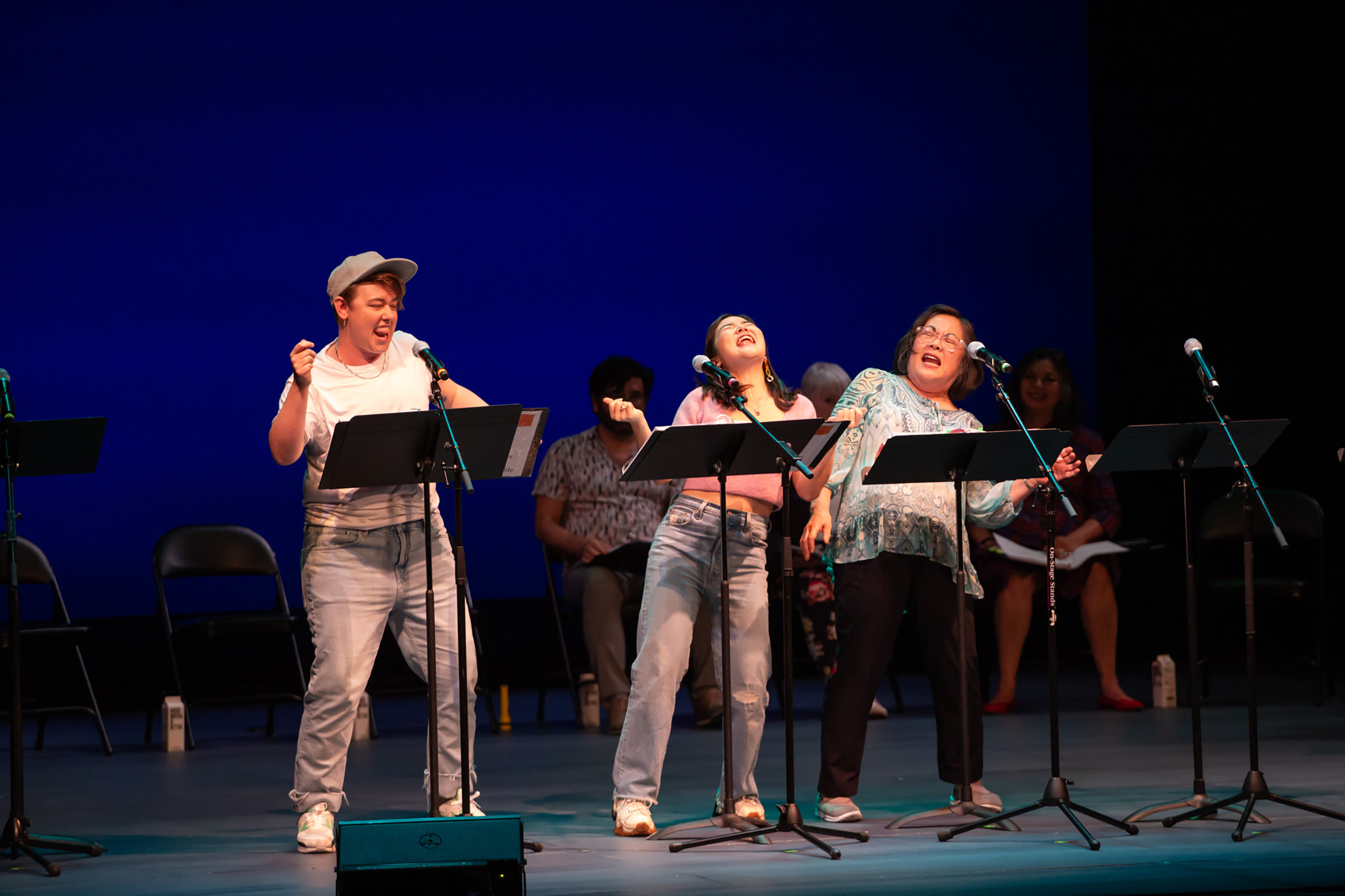

Portrait of Laramie

Theatre Company production of
The Laramie Project.
Three years ago, Moisés Kaufman and his Tectonic Theater Project astounded critics and audiences with Gross Indecency: The Three Trials of Oscar Wilde, a gripping dramatic piece based on events that occurred at the end of the 19th century. But the subject of Tectonic’s latest work is much more immediate in temporal–and emotional–terms.
For The Laramie Project, Kaufman and his colleagues wanted to explore the feelings and reactions of people in Laramie, Wyoming to the heinous, homophobic murder of young Matthew Shepard there in October 1998. Less than a month after Shepard’s death, company members traveled to Laramie and began to conduct a series of interviews with the townspeople. In return trips over the course of the next year, they amassed 200 or more interviews that ultimately served as the basis for their new piece.
The award-winning original production of Gross Indecency ran for more than 600 performances in New York, then went on to Los Angeles (the Mark Taper Forum), San Francisco (Theater on the Square), Toronto (Canadian Stage), and London’s West End (Gielgud Theatre); the play has since had scores of other stagings throughout the U.S. and abroad. The Laramie Project garnered tremendous attention in its recent premiere engagement at the Denver Center Theatre Company, and will surely create even more of a stir upon its Off-Broadway opening at the Union Square Theatre on May 18. TheaterMania asked three of the Tectonics–John McAdams, Andy Paris, and Greg Pierotti–to compare and contrast their experiences on both shows.
****************************************
TM: What is it like to do a theater piece about events that happened in the immediate past, rather than a century ago?
PARIS: The biggest difference is that, in playing a bunch of characters who are long dead and about whom very little has been written–except for Oscar Wilde–we were pretty much at liberty to do whatever we wanted. Also, those events have been processed in people’s minds, and are not so immediate. Here, we not only have people who are living, but whom we’ve spent time with. That brings with it the responsibility to get across the truth about what you’ve seen and heard of this person. And the fact that the Matthew Shepard murder was so recent brings up a lot of issues, because it’s still so painful and raw.
McADAMS: There was a night when Oscar Wilde’s great-grandson came to see Gross Indecency, and that made the whole thing seem very contemporary. But another major difference between the two shows is that there’s a finite amount of information on Oscar Wilde, while the Matthew Shepard story is still being written. There are things going on in Laramie right now that should be in our play–and may be in our play at some point.
TM: If one wanted to find a common theme in Gross Indecency and The Laramie Project, it might be that both Oscar Wilde and Matthew Shepard were martyrs. Do you see it that way?
PIEROTTI: Certainly, they were both victimized. There’s still some debate as to what all of the motives were for the murder of Matthew Shepard, but I think it’s pretty safe to say he was victimized for being gay. “Martyr” is an interesting term, and there’s been a lot of discussion about that. Did the media make Matthew into a martyr? Did the Shepards want him to be turned into one? It’s a scary question to try to answer. We’re doing our best to honor what happened–but we’re not from Laramie, and we’re not the Shepards.
McADAMS: It seems clear that [neither Wilde nor Shepard] ever wanted to be martyrs. Wilde wrote about not wanting to be pigeonholed as having a certain belief, and that being homosexual didn’t define who he was.
PIEROTTI: People want to identify with these men. They project upon them their own sense of suffering and their feelings that they haven’t been treated justly because they’re gay. All of that can be attached to these two figures pretty easily.
McADAMS: Even Dennis Shepard, Matthew’s father, accepted the label of martyr for his son. He said, “It’s okay if people want to say that.” I don’t think that’s necessarily how he himself looks at it, but Matthew has become a tremendous symbol.
TM: Are the murderers and/or the Shepards represented in the play?
PIEROTTI: Andy plays both Russell Henderson and Aaron McKinney. That material is from trial and interrogation transcripts rather than from interviews we conducted. [Tectonic Theater Project company member] Stephen Belber did actually talk to McKinney, but we don’t use that because it was an unofficial interview, and it wasn’t taped.
PARIS: Part of the theme that runs through the play is that people want to hear from [Henderson and McKinney] because they want to know if those two could articulate what was going through their heads that night. But there was never really a situation where [the murderers] were able to do that. So the fact that we have people talking about wanting to hear them say something, rather than actually having them say something, is correct in terms of our experience.
PIEROTTI: John plays Dennis Shepard in the play. Again, that material is from court transcripts.
McADAMS: We’re thinking about writing Judy Shepard into the play as well; we may try that in previews. The Laramie Project started as an attempt to investigate what was going on in that town. We wanted to talk to the people around the event, rather than the central figures. As time went on and the play evolved, it seemed like it was going to be important to hear from the Shepards and the perpetrators, so we started to pursue interviews and more information in that direction.
PIEROTTI: The through-line of the play is the events that happened, but the tangential experiences of the people in the town are what’s central to The Laramie Project.
[[pg]]

TM: What preconceptions did you have about Laramie that were either confirmed or contradicted?
McADAMS: I was surprised at how suburban it is. I really expected to find cowboys in Wyoming, but Laramie is a university town. It could be anywhere.
PIEROTTI: One of the characters I play, Sergeant Hing, said in our interview that the media picture of Laramie was that people there had six fingers and sat around the porch playing the banjo. I never expected to find anything like that, but I definitely thought, “Okay, this place is going to be much less civilized and much more homophobic than New York City.” I had an attitude that was quickly subverted; the people we met there were incredibly sophisticated in their thinking about this whole situation. There were a few who were homophobic, but just a few. And I would say I could have met them anywhere.
TM: But don’t people who have so-called politically incorrect views tend to be less than outspoken about them?
PIEROTTI: Yes and no. A lot of the more homophobic individuals we met felt that they were progressive in their thinking, and were perfectly happy to explain why homosexuals are not quite as good as straight people. But I want to emphasize that that was such a small percentage of the people we met.
PARIS: I’ve spent a lot of time out west, and I grew up in a rural area that had some of that “new-found-suburbia” feel to it, so I wasn’t surprised by what I found in Laramie.
McADAMS: The town was shocked by this death. Everybody said, “This is wrong.” And it was maybe the first time that the country as a whole said “This is wrong” about a murder of this nature. Yet there’s some real opposition to proposed hate crime legislation in Wyoming right now.
TM: How do you describe this kind of theater that Moisés Kaufman and you folks have developed?
ALL (more or less simultaneously): Tectonic!
McADAMS: I wasn’t there so much for the writing of Gross Indecency, but it seems like it has evolved into a much more communal process. It’s very exciting.
PARIS: This time, Moisés invited the company in from the very beginning, before there was even a fully formed idea for the play. When you have performers acting as dramaturgs and associate writers, I think that improves the final theatrical experience, because the actors have a sense of ownership of the material. You have a bigger stake in the show, because you were part of creating it. It’s a very positive way of bringing a story to the stage.
PIEROTTI: Our goal in going to Laramie was to see if there was a play that we could write. And there was.
Featured In This Story