

Bad Café Chat

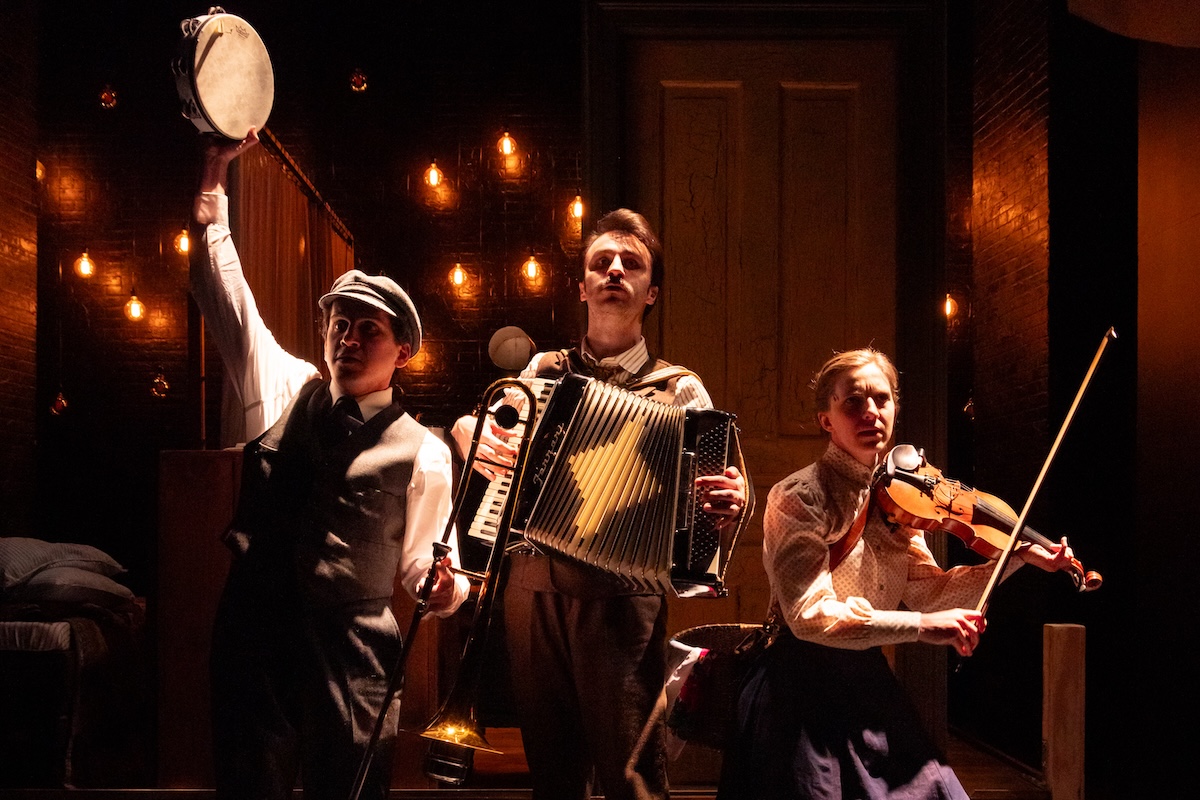
In their latest collaboration as the legendary lesbian-feminist theater troupe Split Britches, Peggy Shaw and Lois Weaver are joined by performance artist Stacy Makishi in Salad of the Bad Café, playing through March 4 at La MaMa. A tale of unrequited love, the play is set in the summer of 1945 when Japan was weeping, the American South was seething, and the word “gender” was mostly used in grammar class.
TM: How did Salad of the Bad Café come to be?
SHAW: Stacy’s fault.
MAKISHI: I love Carson McCullers’ Ballad of the Sad Café. And I thought we sort of matched those characters: Peggy being Amelia, the big, sort of Amazon woman…
WEAVER: And me being the mean husband.
MAKISHI: No offense, Lois! She does this sort of carnivorous husband.
WEAVER: (Snorts like a beast) I jumped at the chance to play that.
TM: Actually, Lois, you do seem to be trying to break out of your stereotype femme roles.
WEAVER: It’s funny–over the years I’ve been obsessed with the idea of femininity and its representation on stage, and the difficulty with talking about “femmeness” as opposed to “butchness”. Butchness seems to be easier to identify and theorize about. And yet it seems like the more I struggle with that, the more butch I get on stage. Joan Nestle wrote that the older you get, the more butch you get, and I resist that idea. I keep thinking I’m going to dye my hair and go back to that hyper-femme. But for now it’s more restful to play the butch; it’s not as high maintenance.
SHAW: Well, it’s easier to jump on a table in a suit [as Lois does in Salad] then to try that in heels.
WEAVER: Well, I wouldn’t say that. This is a huge subject between us, actually.
MAKISHI: (laughing) Be careful Peggy.
SHAW: Why? No, I’m not going to be careful. I think it’s as you said: When you get older, it’s high maintenance to be femme.
WEAVER: But I think I got confused just now because I was talking about in my life. I made a choice recently to not be high femme on a day-to-day basis. [At the same time] I have made the choice to play the butch in this show. But I think those are two different things.
TM: Do you find yourself, Peggy, trying to expand from your usual butch role, like in the scene where you’re wearing a dress?
SHAW: No, I’m only wearing a dress under pressure. The argument we have at the top of the show is exactly what happens: I’m not comfortable in a dress, I don’t want to wear one, but somebody has to wear a dress.
WEAVER: We’ve had that fight over and over.
MAKISHI: Over the last three years.
SHAW: Brutally.
WEAVER: And so finally we had enough distance from it to have the real fight. Peggy and I reconstructed the argument and Stacy furiously took notes and we lifted lines from that.
SHAW: We don’t make anything up. In that way, we’re not very creative. We share a certain aesthetic of reality and truth, trying to find some truth for ourselves because so little has been written about women that’s been true.
[[pg]]
TM: You did this show in London, then took it apart and reassembled it. Why?
SHAW: I think we just weren’t happy. We’re tackling a lot of new things. Our aesthetic is an uncensored, unbridled one. But when you’re dealing with a person of color in the cast–Stacy doesn’t have a right to be that in a way. We’ve gone through the criticism from the queer community, saying we shouldn’t do this, we shouldn’t do that.
WEAVER: We shouldn’t represents lesbians this way, we shouldn’t represent
lesbians that way. We’ve been through that on the gender and sexuality front, but it’s another thing on the interracial front. I also think the difficulty of the stories became our difficulties. Peggy and I had worked together, so there was a history–a history that was very difficult and very fraught. But because we’ve worked together, we have a very easy vocabulary, we’re a couple identified by the audience. So it was important to make sure there was a balance between the three of us. The issues [in Salad] around leaving and being left were real issues that we were all going through: Stacy had come to live with Peggy in New York, and then had come to live with me in London. There’re lots of jealousies–not romantic, but friendship jealousies.
SHAW: They’re pretty romantic.
TM: What was a major wish for each of you as you created your characters?
WEAVER: To be mean. I wanted to play a certain aspect of nastiness in Tennessee Williams. He was racist and sexist and yet there were lots of other things about him that were quite radical. I wanted to play that contradiction.
MAKISHI: My fantasy was to portray gay male sex. I think that’s pretty sexy. I wanted to be a cowboy and get it on with some dude, and in that last scene where my hand goes limp, I don’t know–I wanted to ejaculate basically. (Laughs) The character sort of fails. That’s something personal in terms of my sexuality, I suppose. Everything is autobiography.
SHAW: My wish was NOT to wear a dress. I’m not getting my wish. But I realized last night in watching Lois–I haven’t told this to you–
WEAVER: No.
SHAW: I feel like I finally had to wear the dress so that she could be this really wild beast who jumps on the table and tries to eat me up. For whatever reason, she hasn’t been able to do that before. So I just sat there last night realizing, “Oh, that’s why I’m doing this, so that Lois can do that.” That felt really good.
WEAVER: It’s really interesting what that says about the butch-femme dynamic, isn’t it? That whole binary: In order for me to play that, there has to be this other. You see a butch persona is a resistant persona because it resists the dominant culture’s idea of what it is to be female, just like a drag queen resists the dominant culture’s idea of what it is to be male. My position has always been that you could do that as a femme. A resistant femme resists the idea of what it is to be female by being hyper-female. But it’s exhausting. It’s a relief to take that level of resistance and put it into a male suit. It’s not that I feel I have to put on the suit in order to feel powerful. I am able to be powerful in a dress. But I’ve made this other interesting choice because Tennessee Williams was a feminized male and one way to study femininity is to do it inside that particular male and his relationship to masculinity, and certainly his relationship to his female characters, whom I’ve always just loved.
SHAW: Yeah, but I don’t really think of it as a costume thing that we’re going through. I don’t know. It’s really hard to figure out.
TM: Will you ever be willing to be butch at the same time?
WEAVER: Peggy’s at that place now. For me, it’s not so easy. It’s that difficulty I have with the feminine being invisible then. If I’m going to be a butch, there still has to be a dress on stage, otherwise we’ve rendered the feminine completely invisible.
Featured In This Story