The Secret in the Wings

The Secret in the Wings
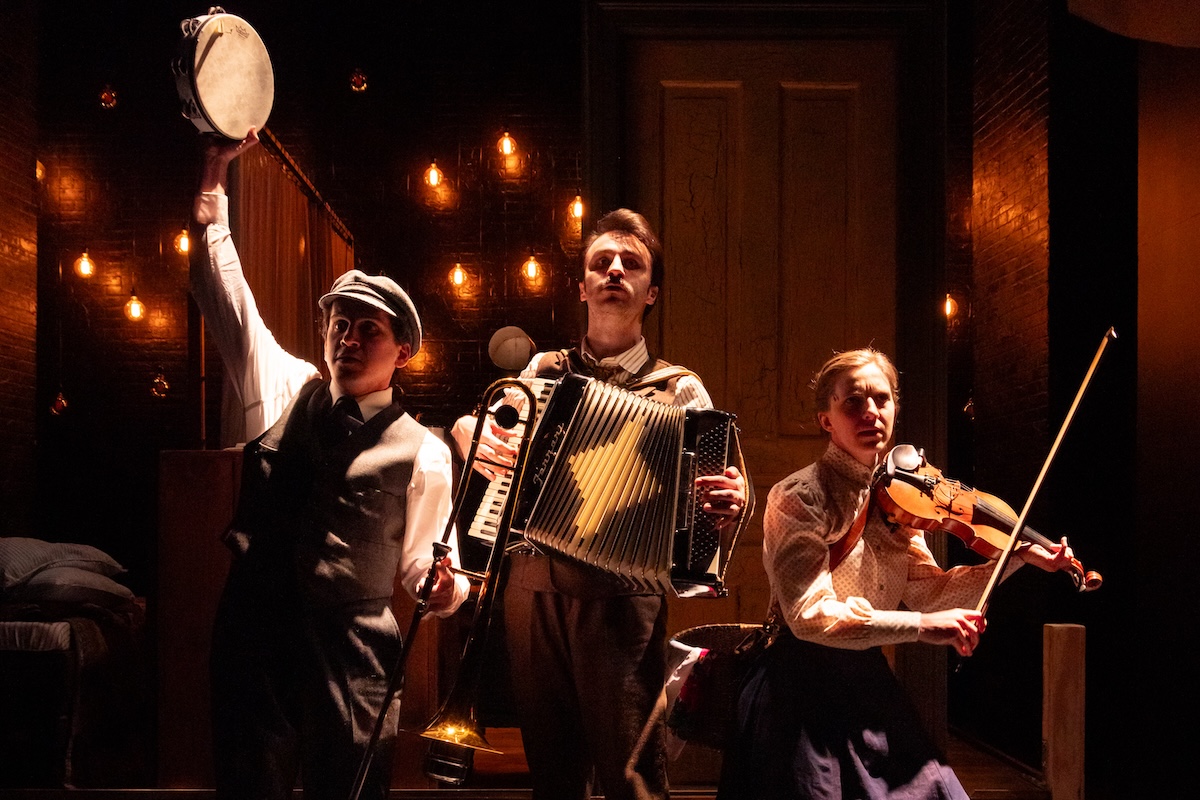
(Photo © Michael Brosilow)
In Chicago, any new show by adapter/director Mary Zimmerman is highly anticipated, whether at the Goodman Theatre (where she is the Manilow Resident Director) or at Lookingglass Theatre Company (where she is an ensemble member). Zimmerman also has a high national profile since winning a 2002 Tony Award for the Broadway stand of Metamorphoses (which originated at Lookingglass). Her productions of The Arabian Nights, The Notebooks of Leonardo DaVinci, Journey to the West, and The Odyssey have played regional theaters nationwide and Off-Broadway, so expectations are exceedingly high for Zimmerman. As with any artist, she occasionally fails to strike fire; The Secret in the Wings, at Lookingglass Theatre through November 23, is such an occasion.
Expanding material she workshopped for 12 performances in 1991, Zimmerman has drawn on lesser-known European fairy tales to produce an 85-minute reverie of dark Freudian corners, fantastic enchantments, and primeval emotions and fears. A few of the tales are somewhat familiar — a Beauty-and-the-Beast framing piece, a Cinderella-like story involving a ring, not a glass slipper — but most are not. Even the unfamiliar tales contain such standard elements as a wicked queen, an ogre, the granting of rash wishes (as Sondheim wrote, “Be sure that what you wish is what you want”), and the rewards of self-sacrifice or extending trust beyond what your eyes see (e.g., kissing the frog).
The problem is that Zimmerman relates few stories in full and none straight through. The fairy tales, perhaps a dozen altogether, are told through dialogue, direct address to the audience, songs, and the almost-choreographed physical style that is a Zimmerman hallmark. But everything is fragmented, story overlays story, and bits and pieces of tales that are never completed share space with the main narrative lines. At times, the collage of techniques and the montage of tales assume a level of abstraction that’s impossible to follow; the reverie of visual and aural landscapes becomes a fevered dream from which the dreamer/audience wants out.
There is plenty of moment-to-moment emotional color but no apparent cumulative point to The Secret in the Wings. Enveloped by a sense of foreboding and menace, none of the work’s tales comes to a completely happy ending. As a result, the audience leaves without having had a deep or complete experience.
A typical Zimmerman work looks sumptuous or at least elegant, but Zimmerman’s longtime design team has downscaled this time. Daniel Ostling’s set features an undefined, dingy house with a long set of open-backed stairs, a small loft, a gloomy coal cellar, a trap door to nether regions, and a large open space. It’s limbo. A few 1940s-vintage floor lamps sometimes cast the only light in T. J. Gerckens’ delicately brooding design. Mara Blumenfeld’s costumes consist chiefly of somewhat shabby formal wear of 40 or 50 years ago. The only majesty for the many kings and royals who people the tales is a set of red velvet and gold-gilt chairs, and strikingly designed jeweled coronets that the performers wear as needed. Even champion composers Andre Pluess and Ben Sussman have hit a wall here: Their lilting, folkloric songs and quiet underscoring are luminous, but an elaborate sound collage — voices, music, sound effects — is the centerpiece of the show’s most abstruse segment.
The nine players, eight of them Zimmerman veterans, all take multiple roles and are not identified by specific character names. Nameless, faceless, and interchangeable (except for Tony Fitzpatrick as The Ogre), they disappear within the ensemble, each a nimble and graceful pantomimist and an able speaker.
Mary Zimmerman at her least interesting remains a cut above most directors at their peaks. The Secret in the Wings is an imaginative, highly theatrical, compact, and complex work. But it’s a rest stop on Zimmerman’s journey, not a new frontier.